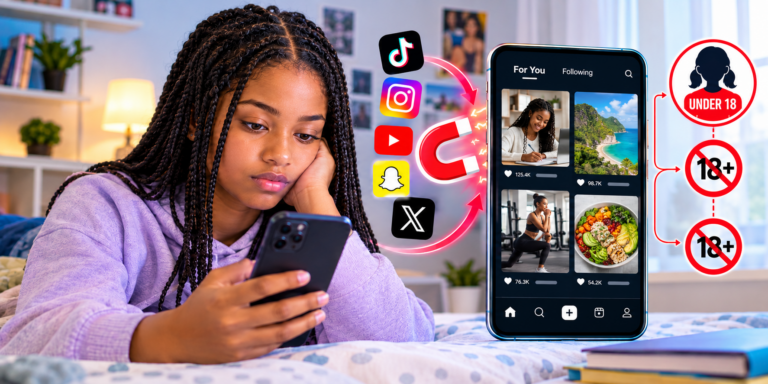
A mother in Lagos sits across from her fourteen-year-old daughter. She just found suggestive photos on the girl’s phone. The photos were not sent to anyone. They were taken to post online. The daughter does not see the problem. “Everyone posts pictures like this,” she says. “The popular girls in my class have thousands of followers.”
The mother feels helpless. She thought she was doing the right things. She monitored the phone. She set screen time limits. She talked about online safety. Yet somehow her daughter was still influenced by a culture she did not create and cannot control.
Parents across the world are losing this battle. Not because they are bad parents. Not because they do not care. But because they are fighting against systems engineered to defeat them. The platforms, the algorithms, and the culture they create are more powerful than any individual parent’s efforts.
The Enemy Is Invisible
Parents think they are protecting their children from strangers. The real danger is more subtle.
It is not the stranger messaging your child. It is the algorithm serving your child content you do not know they are seeing. It is the normalization that happens gradually, one post at a time. It is the peer pressure that comes from every other child being exposed to the same content.
You cannot block what you cannot see. You cannot prepare your child for content you did not know existed. By the time you realize what your child has been exposed to, the exposure has already shaped their thinking.
The platforms know what your child sees. They have the data. They do not share it with you. Parental controls give you a false sense of security. The real feed remains hidden behind privacy features that protect the platform’s access to your child more than your child’s safety.
The Technology Gap
Most parents are not as technologically savvy as their children. Children grew up with this technology. It is native to them. Parents adopted it later. They do not understand it fully.
A parent might set up parental controls on the main device. The child has a second device the parent does not know about. Or uses a friend’s phone. Or accesses content through a browser the parent did not restrict. Or uses an app the parent has never heard of.
Even when parents understand the technology, the platforms change constantly. New features appear. New apps emerge. New loopholes are discovered. The parent is always playing catch-up.
The platforms count on this. The more complex the environment, the harder it is for parents to supervise effectively. The failure of parental control is built into the system.
Peer Pressure Overpowers Parental Guidance
You raise your child with values. You teach them right from wrong. You explain why certain content is harmful. Then they go to school.
At school, they meet children who have no restrictions. Children who consume any content they want. Children who share what they have found. Your child wants to fit in. They want to be part of the group. The group is consuming this content. Your child follows.
The peer pressure is not malicious. It is normal adolescent behaviour. Children have always influenced each other. What has changed is what they are influencing each other toward. The content available today is more explicit, more accessible, and more normalized than at any point in history.
Your values compete with the values of every child your child interacts with. And the children are being shaped by platforms that profit from their engagement. You are fighting a battle where your opponent has access to your child for hours daily while you have them for minutes.
The Time Disparity
Here is the reality parents face.
Your child spends six to eight hours daily on their phone. Time at school where phones are hidden but present. Time after school before you return from work. Time in their room at night when you think they are sleeping.
You spend perhaps one hour daily in meaningful conversation with your child. One hour of influence against eight hours of platform influence. The math does not work in your favour.
Even if you use your one hour wisely, the other eight hours are shaped by content designed to capture and hold attention. The content does not share your values. The content teaches different lessons. The content shapes your child’s understanding of the world.
You cannot win a battle where the opposing force has eight times your influence.
What Parents Are Trying
Parents have not given up. They are trying various strategies with varying degrees of success.
Strict monitoring works for younger children but becomes difficult with teenagers. Teenagers demand privacy. Excessive monitoring damages trust. The teenager finds ways around the monitoring anyway.
Open communication helps but only if the child is willing to talk. Many children hide their online activity because they know their parents will disapprove. The secrecy widens the gap.
Religious and moral teaching provides a foundation but cannot compete with daily exposure to contrary messages. The foundation erodes under constant pressure.
Removing devices entirely isolates the child socially. They become the only one without a phone. The isolation breeds resentment. The resentment pushes them toward the very content they were denied.
No strategy is fully effective because the problem is not individual. It is systemic. Parental effort alone cannot counteract an entire ecosystem designed to exploit young people.
What Would Actually Help
Real solutions require more than individual parental effort.
Age verification that actually works would limit access. Platforms claim age restrictions but enforcement is minimal. A child can lie about their age in seconds. Real verification would require government ID or parental consent. The platforms resist this because it would reduce user numbers and therefore revenue.
Algorithm changes would reduce exposure. Platforms could design algorithms that do not push suggestive content to young users. They choose not to because engagement drives profit.
Transparency would empower parents. If platforms were required to show parents exactly what their children see, parents could respond appropriately. The platforms resist transparency because it would reveal how badly they have failed.
Accountability would change behaviour. If platforms faced real consequences for exposing children to harmful content, they would invest in protection. Currently, the consequences are minimal. Fines are small relative to profits. Liability is avoided through legal protections.
What You Can Do Now
Accept that the battle is hard. You are not failing because you are inadequate. You are fighting a system designed to defeat you.
Focus on relationship rather than control. A child who trusts you will tell you what they see. A child who fears you will hide everything. Build trust even when it means hearing things you do not want to hear.
Educate yourself. Know the platforms your child uses. Understand how algorithms work. Learn about the content that circulates. You cannot protect against what you do not understand.
Educate your child. Not just about what is wrong. About why it is wrong. About how the platforms manipulate. About how the algorithms exploit. Knowledge is the only defence that works when you are not there.
Choose better platforms. Some platforms are designed to protect rather than exploit. ModafVibe is one of them. A platform with zero adult and explicit content. A platform where the algorithm does not push harmful material. A platform where your child can connect without being exposed to content you would never approve.
The mainstream platforms will not protect your child. They profit from your child’s attention. ModafVibe was built differently. We do not allow adult content. We do not profit from exploitation. We built a safe space because safe spaces should exist.
The battle is hard. But you do not have to fight it alone. And you do not have to send your child into a space designed to harm them. Join ModafVibe. Give your child a social media home that does not work against you. That is not weakness. That is wisdom.