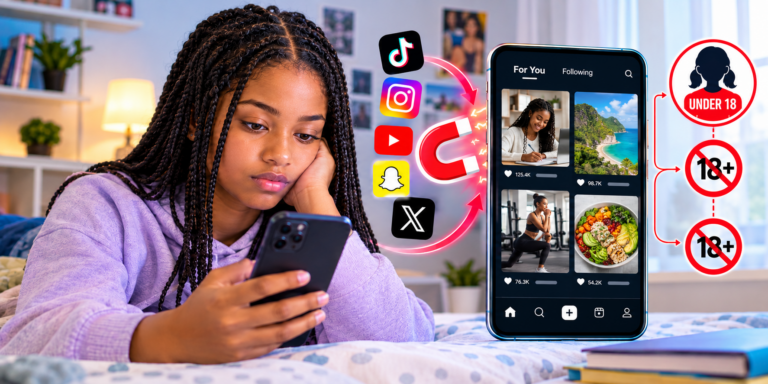
A thirteen-year-old creates a TikTok account. They select their interests. Music, comedy, sports. Nothing inappropriate. They scroll their For You page for the first time. The content matches their selections. Harmless videos. Funny clips. Sports highlights.
Within two weeks, their feed has changed. Suggestive dance videos appear between the comedy clips. Accounts with provocative thumbnails show up in their suggestions. They did not search for this content. They did not follow accounts that post it. Yet the algorithm decided they should see it.
This is not a rare occurrence. It is the normal experience for young users on mainstream platforms. The algorithm learns what captures attention, and explicit content captures attention. It does not need the user to search for it. It only needs the user to pause on it once.
How Recommendation Algorithms Actually Work
The algorithm’s goal is simple. Maximize time spent on the platform. Every decision flows from that goal.
When you watch a video, the algorithm records that behaviour. It notes how long you watched. Whether you liked it. Whether you shared it. Whether you watched it again. This data builds a profile of what holds your attention.
The algorithm then predicts what else might hold your attention. It tests predictions by showing you new content and measuring your response. Content that holds your attention is shown more. Content that does not is shown less.
The algorithm does not judge content quality. It judges engagement potential. A beautifully produced educational video that people scroll past loses to a suggestive video that people watch twice. The algorithm does not care which is better for you. It cares which keeps you on the app.
The Gradual Drift
Young users do not go from harmless content to explicit content in one jump. The drift is gradual. Each step feels small. Each piece of content is only slightly more suggestive than the last.
It starts with a dance video that is mildly suggestive but still mainstream. The algorithm notices the user watched it fully. It serves a similar video. Then another. Then one that is slightly more revealing. The user pauses on this one. The algorithm records that pause.
The next session includes more content in that category. A fitness video with excessive focus on body parts. A fashion video that is really about showing skin. A comedy skit with suggestive themes. Each piece is only marginally different from the last. The trend line points steadily toward explicit content.
The user never searched for anything inappropriate. They never followed inappropriate accounts. They simply responded to what the algorithm served, and the algorithm responded to their responses. The system optimized toward explicit content because explicit content optimizes toward engagement.
Why Young Users Are Particularly Vulnerable
Adolescent brains are wired for novelty and reward. The dopamine response to new and exciting content is stronger in teenagers than in adults. This makes young users more responsive to the algorithm’s suggestions.
Teenagers are also less likely to recognize the drift. They do not have the context to understand that their feed was different two weeks ago. They simply accept what appears as normal. The gradual nature of the drift hides it from conscious awareness.
Curiosity is natural at this age. Seeing mildly suggestive content sparks curiosity about more explicit content. The algorithm feeds that curiosity. The user follows. The cycle accelerates.
The Engagement Trap
Once the algorithm has categorized a user as responsive to suggestive content, escaping that categorization is difficult.
The user might decide they do not want to see such content. They scroll past it. They click not interested. They block accounts. The algorithm adjusts slowly. It continues testing with similar content because past behaviour suggested strong engagement. It takes consistent, deliberate effort to retrain the algorithm.
Many young users do not have the awareness or discipline to do this retraining. They continue receiving a feed that increasingly features suggestive content. What began as a gradual drift becomes their new normal.
Platform Responsibility and Accountability
Platforms claim their algorithms are neutral. The algorithm reflects user preferences, they say. If a user sees explicit content, it is because they engaged with similar content.
This defence ignores the power imbalance. The platform controls what content exists in the pool. The platform controls how the algorithm prioritizes. The platform decides whether to design for engagement or for user wellbeing.
A platform that cared about young users would design algorithms that recognize when a user is likely a teenager and adjust content accordingly. It would cap the rate at which suggestive content appears. It would require explicit search before serving explicit content. It would allow users to permanently opt out of entire content categories.
These technical solutions exist. They are not implemented because they would reduce engagement. The platform’s defence of neutrality masks a choice to optimize for profit over protection.
What Parents Need to Know
Parental controls are not enough. Filters do not catch algorithmic drift. Restricted mode does not prevent gradual exposure. The content appears in the normal feed, not in clearly marked adult spaces.
Conversations with children matter more than controls. Explain that the platform is designed to keep them watching. Explain that what appears in their feed is not random but chosen based on what keeps them engaged. Help them recognize the drift when it happens.
Monitor without spying. Ask what they see on their feed. Ask what content appears frequently. If suggestive content is appearing, help them understand why and how to push back against it.
Create account together. Choose interests carefully. Review the feed together in the first weeks. Talk about what appears and why. Make the algorithm’s behaviour visible and understandable.
Frequently Asked Questions
Can I reset my algorithm to remove explicit content?
Yes but it takes effort. Clear your watch history. Unlike problematic content. Use not interested buttons consistently. Search for and engage with content you actually want. The algorithm adjusts over days and weeks, not instantly.
Do private accounts see less explicit content?
Private accounts still receive algorithmic recommendations. Privacy settings control who sees your content, not what content you see.
Does marking content as not interested actually work?
It works when used consistently. Occasional use is not enough. The algorithm needs repeated signals to shift its understanding of your preferences.
Are some platforms worse than others?
Yes. Platforms with strong emphasis on short-form video and algorithmic discovery tend to push more suggestive content because it drives engagement. Platforms where users primarily see content from accounts they follow give users more control.
The Solution Requires Different Incentives
Mainstream platforms will not solve this problem because their business model depends on it. Engagement is revenue. Suggestive content drives engagement. The incentive structure prevents genuine protection.
The alternative is platforms built with different incentives. Platforms that measure success by user wellbeing rather than time spent. Platforms that design algorithms to protect rather than exploit. Platforms that treat young users as people to nurture rather than attention to harvest.
ModafVibe exists for this reason. We built a platform where the algorithm’s job is not to maximize your time but to respect your boundaries. Where content is safe by default, not by request. Where young users can explore without the gradual drift toward explicit content.
The mainstream platforms made their choice. The choice does not have to be yours.