Every business advisor will tell you to write a business plan before starting. They are right. A business plan helps you think through your idea, understand your market, and plan your finances. Without one, you are operating on hope and guesswork.
The problem is that writing a business plan feels overwhelming. The templates online are designed for American or European markets. The language is formal and corporate. The financial sections assume you understand accounting terms that were never taught in Nigerian secondary schools.
Many Nigerian entrepreneurs give up on business plans entirely. They start their businesses without one and figure things out as they go. Sometimes this works. Often it leads to costly mistakes that a few hours of planning could have prevented.
AI tools have changed this equation. You can now create a practical, Nigeria-specific business plan in hours instead of weeks. This guide shows you exactly how to do it using free AI tools.
Before You Start: What a Nigerian Business Plan Actually Needs
Forget the 50-page documents that business school textbooks describe. Most Nigerian small businesses need something simpler and more practical.
A useful business plan for the Nigerian market should answer these questions. What exactly are you selling and to whom? Why would someone buy from you instead of the competition? How much money do you need to start? Where will that money come from? How long until the business becomes profitable? What could go wrong and how will you handle it?
If your plan answers these questions clearly, you have a solid foundation. You do not need fancy charts or corporate jargon. You need honest thinking presented clearly.
The Small and Medium Enterprises Development Agency of Nigeria, SMEDAN, offers support for small businesses. A clear business plan helps you access these opportunities. Some grants and loans require a plan as part of the application. Even if you are bootstrapping, the plan keeps you focused.
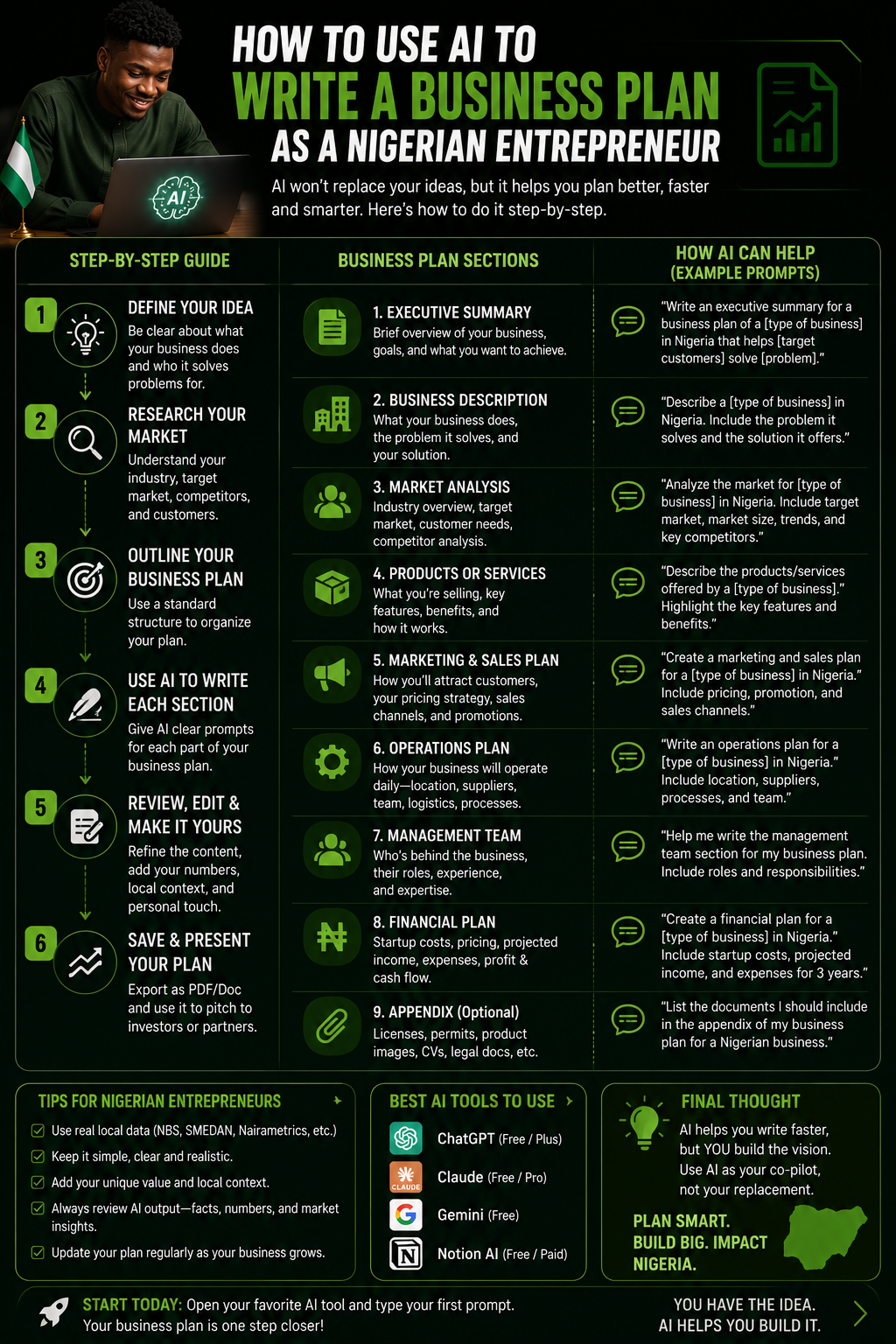
Step 1: Define Your Business Idea Clearly
Start by writing down your business idea in plain English. Do not worry about sounding professional. Just explain what you want to do as if telling a friend.
For example, instead of saying “I want to start a logistics and supply chain management enterprise,” say “I want to buy foodstuffs in bulk from Northern farmers and sell them to market women in Lagos.”
Once you have your plain explanation, open ChatGPT or Poe. Use this prompt:
“I am starting a business in Nigeria. My idea is to buy foodstuffs in bulk from Northern farmers and sell to market women in Lagos. Help me refine this business idea by asking me ten important questions I need to answer to make this work.”
The AI will ask you questions about sourcing, transportation, pricing, competition, and more. Answer each question honestly. This conversation will clarify your thinking more than any template.
Step 2: Research Your Market Using AI
Market research sounds expensive. It brings images of surveys, focus groups, and consultants. But for a small Nigerian business, practical market research is simpler.
You need to understand who your customers are, what they currently do, and why they might switch to you. AI helps you think through these questions systematically.
Use this prompt with ChatGPT or Poe:
“I am starting a business selling foodstuffs from Northern Nigeria to market women in Lagos. Help me analyze my target market. Who exactly are my customers? What are their current buying habits? What problems do they face with current suppliers? What would make them switch to me?”
The AI will generate a structured analysis. It will not have specific data about Lagos market women. You must verify and supplement with your own knowledge. But the structure it provides ensures you do not miss important angles.
Next, ask the AI to help you think about competitors:
“Who are my likely competitors in this foodstuff distribution business? Include both direct competitors doing the same thing and indirect competitors like existing market structures that my customers currently use.”
The AI will identify competitor categories you might not have considered. Again, the specific names and details must come from your own knowledge of the market. The AI provides the framework.
Step 3: Create a Realistic Financial Plan
This is where most Nigerian entrepreneurs struggle. Financial projections feel like guesswork. How do you predict sales before you have started?
AI cannot give you exact numbers for your specific business. But it can help you build realistic estimates based on reasonable assumptions.
Start with startup costs. Use this prompt:
“I am starting a foodstuff distribution business from the North to Lagos. Help me list all the startup costs I should consider. Include obvious costs like buying initial stock and transportation, and less obvious costs like packaging, storage, and small bribes or settling at checkpoints.”
The AI will generate a comprehensive list. Go through each item and estimate the cost in naira based on your knowledge. Add items the AI missed specific to your situation.
Now for revenue projections. Use this prompt:
“Help me create realistic monthly revenue projections for my first year. Assume I start small, selling 10 bags of onions and 10 bags of tomatoes weekly. The business grows slowly as market women trust me. What factors should I consider when estimating monthly income?”
The AI will help you think about pricing fluctuations, seasonal changes, and growth assumptions. It will not give you exact numbers but it will help you build your own projections on solid logic.
Finally, ask the AI to help you calculate your break-even point:
“Based on the startup costs and monthly projections we discussed, help me calculate when this business will likely break even. What factors could delay profitability?”
Step 4: Think Through Risks Honestly
Nigerian businesses face unique risks. Insecurity on certain routes. Fluctuating exchange rates affecting input costs. Government policy changes. Market fires or demolitions. Middlemen who delay payments.
AI might not automatically consider these Nigerian-specific risks. So tell it to:
“I am running this foodstuff business in Nigeria. Help me think through risks that are specific to the Nigerian business environment. Include infrastructure problems, security issues, market disruptions, and political risks.”
The AI will generate a risk list. Go through each one and write down how you would handle it if it occurred. This contingency planning is what separates prepared entrepreneurs from those constantly firefighting.
Step 5: Assemble Everything Into a Document
By now you have content covering your business idea, market analysis, competitor review, financial projections, and risk assessment. You have answered the key questions that matter for a Nigerian small business.
Now assemble everything into one document. Use this prompt:
“I am going to paste several sections of my business plan. After I paste everything, help me organize it into a clean, professional business plan with these sections: Executive Summary, Business Description, Market Analysis, Competitor Analysis, Marketing Strategy, Financial Plan, and Risk Analysis. Keep the tone professional but simple. Avoid corporate jargon.”
Paste your notes and let the AI organize them. The result will be a coherent business plan document.
Review everything carefully. The AI has organized your thoughts but the thinking is yours. The numbers are your estimates. The market knowledge comes from you. The AI was a tool, not the author.
Step 6: Format for Your Specific Purpose
Different situations require different formats. A business plan for a loan application looks different from one for your personal use.
If you need a plan for a bank loan, ask the AI to adjust the tone and add sections that banks care about. Collateral, repayment plan, and detailed cash flow projections.
If you need a plan for a grant application, ask the AI to emphasize the social impact angle. How will your business create jobs or solve a community problem?
If the plan is for your own guidance, keep it simple and action-focused. The best business plan is the one you actually use, not the one that looks impressive in a drawer.
What AI Cannot Do For You
AI will not validate your market assumptions. Only talking to real customers does that. Before finalizing your plan, speak to at least five potential customers. Show them your idea. Listen to their reactions. Adjust based on what you hear.
AI will not give you accurate local prices. You must research these yourself. Visit markets. Talk to suppliers. Get real quotes. The financial section is only as good as the numbers you input.
AI will not predict the future. Your business will face surprises. The business plan is a guide, not a contract. It helps you start with clarity and adapt with intelligence.
Start Today
Open ChatGPT or Poe on your phone. Start with the first prompt in Step 1. Spend thirty minutes on this today. The hardest part of writing a business plan is starting. AI makes starting easier than ever.
A practical business plan written with AI assistance is better than a perfect plan that exists only in your imagination. Get your ideas out of your head and onto the page. Your business deserves the clarity that comes from proper planning.